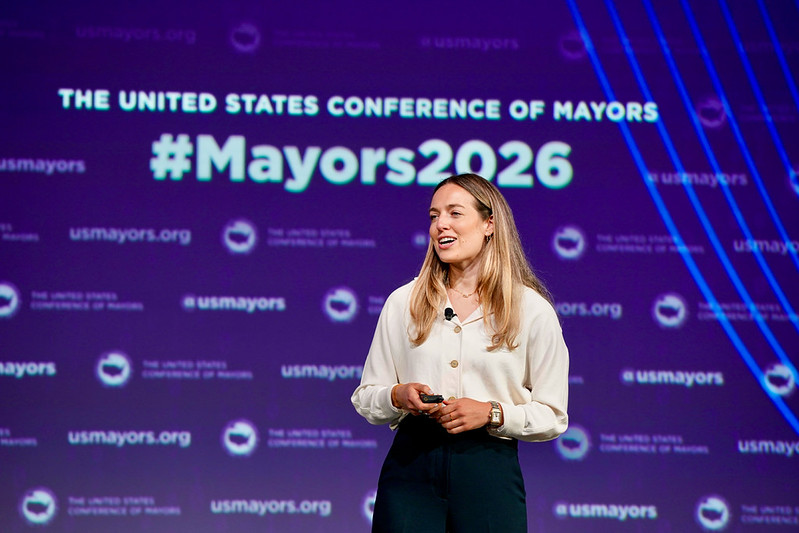

At Tomorrow.City USA 2026, Smart City Expo's flagship U.S. event, Chief AI joined a gathering of 2,000 public, private, and philanthropic leaders working to shape the future of cities.
The event convened mayors, CIOs, founders, investors, researchers, and civic technologists around a shared set of questions: How do we make cities more effective, digitally connected, and sustainable? How do we support the rise of AI and data centers, advance frontier research, and build a workforce ready for what's next?
For Chief AI, the week offered two distinct opportunities to contribute to those conversations: moderating a panel with city CIOs and pitching in the startup competition.
Moderating "Data in Action: Building Community Buy-In"
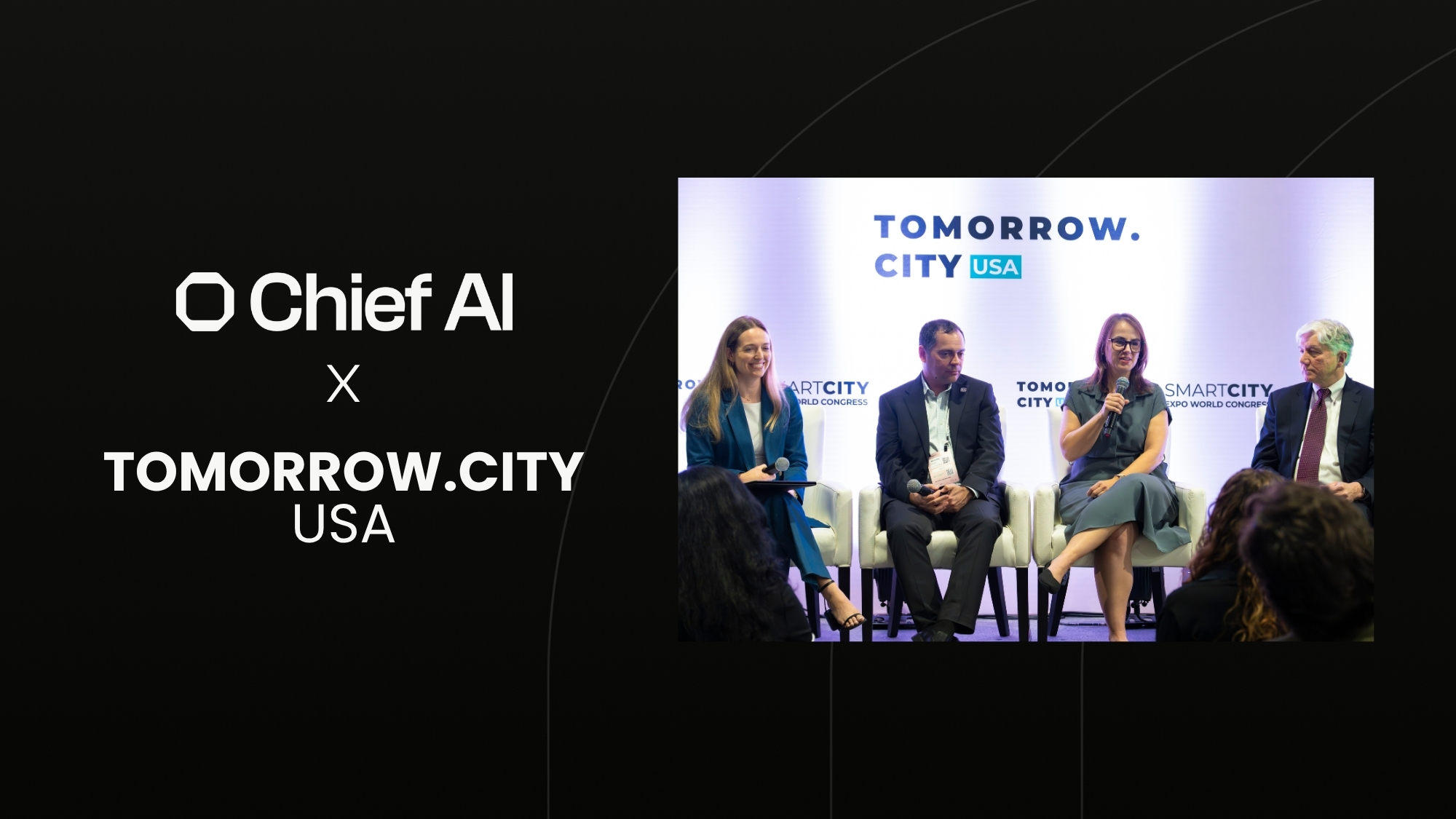
On the Pioneer Stage, Chief AI Founder and CEO Shannon Beckham moderated a panel exploring one of the most pressing questions in modern city government: how do you lay the foundation of data in the age of AI?
Cities generate more data than ever before, yet the gap between data collection and meaningful community impact remains wide. The conversation traced a deliberate arc from the state of data in local government today, to AI as the inflection point raising the stakes on data quality, to what forward-leaning cities are doing in practice to close the gap.
Kelly Williams, the first-ever Chief Innovation Officer for the City of Oklahoma City, opened with a candid look at the foundational work that has to happen before cities can use data well. Her team built OKC's first formal Data Governance Board from scratch, getting departments to agree on shared definitions, ownership, and quality standards. She illustrated the stakes with a story from her own experience: as someone with a PhD in statistics, she once spent six weeks trying to track down a single dataset — who owned it, whether the city even had it, and how to access it. Had there been a basic data directory, it would have been a 30-minute project. Her bottom line: data literacy, accessibility, and quality have to exist together. You can't shortcut one and expect the others to carry the load.
Raimundo Rodulfo, CIO and Director of Innovation and Technology for the City of Coral Gables, offered a window into what twenty years of sustained smart city investment looks like in practice. Coral Gables has eliminated its technical debt entirely, moved fully to the cloud, and built a digital twin that integrates over 2,000 geospatial datasets across public safety, infrastructure, IoT, and enterprise systems. He walked the audience through how his team partners with local schools and engineers to build agents internally to support city staff and residents. His emphasis: create partnerships in your community to build the technology needed for this next era.
Michael Dunaway, CEO of CIRRUS Group and former Associate Director for Innovation at NIST, brought a national perspective grounded in his decade leading the federal government's Global City Teams Challenge — a program that spent ten years building smart cities standards and interoperability frameworks across the country. He launched CIRRUS Group to continue that work in the private sector. He made the case for open standards, interoperability, and a shared measurement framework. With 90,000 jurisdictions spanning approximately 19,000 cities across the country, AI is what finally enables this work to scale — but only if cities can share data and learn from each other.
Three key takeaways united the panel:
- Data quality is a prerequisite, not a parallel track. AI amplifies whatever is underneath it — which means cities that invest in clean, governed, accessible data will see the greatest returns from AI, and the soonest.
- The work starts at home. Before cities can share data across jurisdictions, they need a clear picture of what they already have — who owns it, how to access it, and what it means. Building that foundation is meaningful progress, even before any AI is in the picture.
- The path forward is more accessible than it looks. Process improvement, university and community college partnerships, and investments in data literacy are available to any city willing to prioritize them — regardless of budget or technical infrastructure.
The cities ready to lead in the AI era are the ones turning data into trust, transparency, and outcomes residents can see in their everyday lives.
Finalist at the Tomorrow.City USA Pitch Competition
Chief AI also competed in Tomorrow.City USA's 2026 Startup Pitch Competition.
On stage, we shared our vision for the operating system for modern leadership starting with mayors and their teams. City leaders make decisions that affect millions of lives, yet still rely on emails, spreadsheets, and briefing binders to run daily operations. As budgets tighten and AI rapidly advances, the gap between rising urban complexity and the outdated infrastructure used to manage it is widening. Chief AI is closing that gap with secure, purpose-built AI agents that support the real work of a city leadership office.
We grounded the pitch in our work with the Mayor of Denver's office, where staff use Chief AI to clear hundreds of scheduling requests, save dozens of hours per week on memo drafting and task coordination, track thousands of stakeholders in a centralized knowledge base, and gain AI-driven insight into how the mayor's time aligns with strategic priorities. As one staffer in the Mayor's office put it: "Chief AI is life changing. It removes hours of process I've done for years. We need this product."
Being selected as one of three finalists at one of the most competitive stages in U.S. urban innovation is a meaningful signal, both for Chief AI and for the city leaders who need tools that help their offices run faster, coordinate better, and deliver more for residents.
The Road Ahead
At Chief AI, we see Tomorrow.City USA as part of a much larger movement. Cities are entering a period of profound transformation and the leaders shaping this future need infrastructure built specifically for the way they work.
We're grateful to the Tomorrow.City USA team, fellow panelists, the leaders who supported our pitch, and the hundreds of mayors, CIOs, founders, and innovators who made the week what it was. The work of modernizing public leadership is just beginning and we're proud to be building alongside the people defining what comes next.